

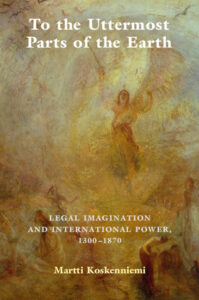
Members of the NYU School of Law community are invited to join a new reading group on the history of international law: sovereignty and property. The group will meet four times during the Spring semester and will focus on reading (mainly chapters from) Martti Koskenniemi’s new book To the Uttermost Parts of the Earth: Legal Imagination and International Power 1300–1870 (CUP, 2021). The reading will culminate in an online public book event co-sponsored by the IILJ and the Hauser Global Program with the participation of Professor Koskenniemi and others. See more information about the book below. Information about the online book event will follow soon.
The reading group’s meetings will be held on Fridays, 3-5pm (by zoom):
First Meeting, February 25th – The Christian notion of dominium widens into “sovereignty” and “property” (introduction & Chapter 1).
Second Meeting, March 18th – Modern liberty, commercial orientation and science at the service of enlightened rulership (Chapter 6).
Third Meeting, April 8th – Global law and the British Empire (Chapter 10).
Fourth Meeting, April 29th – The end of natural law and the emergence of modern international law (Chapter 12).
If you’re interested in joining, please email Karin Loevy (karinloevy@nyu.edu) and she will send you the readings and a link to join.
To the Uttermost Parts of the Earth: Legal Imagination and International Power 1300–1870
This volume presents the key role played by law for Europe’s global hegemony during 1300–1870. By connecting public sovereignty with property rights, it demonstrates how law enabled the concurrent development of political statehood and capitalism in Europe and beyond. Europe’s global power has not been the power of princes or capital alone, but always a specific configuration of the two. To understand this power, the book shows how the relationship of sovereignty and property has its basis in local legal cultures – French, Spanish, British and German. The employment of law in foreign lands has not been a monopoly of lawyers, however, but has been practiced by theologians, political commentators, philosophers and economists. The specific relationship between public and private power has depended greatly on which type of expertise has been regarded as authoritative in the relevant context.